
Why is This Happening to Me?
The first two chapters of Job give us the large-scale scope of what is happening to Job: He is stuck in a cosmic tug-of-war between God and the Accuser, Satan. Satan argues that God has blessed Job, and this is the reason he is righteous. If God would take away everything that Job owns, he would curse God. Job loses his livestock, his servants, and his children, but still does not blame God or sin in any way (Job 1:22). Satan then argues that if God were to strike Job’s flesh, this would surely cause him to curse God, so God allows Job to be infected with terrible boils from the soles of his feet to the top of his head (Job 2:7). Amid all this happening, Job has no knowledge of the machinations behind the scenes. His only reality is the pain and suffering he is experiencing. His wife urges him to curse God and die (Job 2:9). His friends sit silently with him for seven days and seven nights (Job 2:13). But Job must eventually give voice to his anguish.

The first two chapters of Job give us the large-scale scope of what is happening to Job: He is stuck in a cosmic tug-of-war between God and the Accuser, Satan. Satan argues that God has blessed Job, and this is the reason he is righteous. If God would take away everything that Job owns, he would curse God. Job loses his livestock, his servants, and his children, but still does not blame God or sin in any way (Job 1:22). Satan then argues that if God were to strike Job’s flesh, this would surely cause him to curse God, so God allows Job to be infected with terrible boils from the soles of his feet to the top of his head (Job 2:7). Amid all this happening, Job has no knowledge of the machinations behind the scenes. His only reality is the pain and suffering he is experiencing. His wife urges him to curse God and die (Job 2:9). His friends sit silently with him for seven days and seven nights (Job 2:13). But Job must eventually give voice to his anguish.
In chapter 3, Job begins to speak and what he says is shocking. He doesn’t curse God as Satan predicted or even despair of life like Elijah did. Job curses the day he was born. If only God had not created that day, he would be spared this suffering:
“After this, Job began to speak and cursed the day he was born. He said:
‘May the day I was born perish,
and the night that said,
“A boy is conceived.”
If only that day had turned to darkness!
May God above not care about it,
or light shine on it.
May darkness and gloom reclaim it,
and a cloud settle over it.
May what darkens the day terrify it.
If only darkness had taken that night away!
May it not appear among the days of the year
or be listed in the calendar.
Yes, may that night be barren;
may no joyful shout be heard in it.
Let those who curse days
condemn it,
those who are ready to rouse Leviathan.
May its morning stars grow dark.
May it wait for daylight but have none;
may it not see the breaking of dawn.
For that night did not shut
the doors of my mother’s womb,
and hide sorrow from my eyes.’”
Notice how many times the words “may” or “let” show up in Job’s curse. These appearances indicate a specific mood of the Hebrew verb that indicates a wish or suggestion as a command (“Let it be...”). Job’s use of the jussive form here is meant to evoke the creation account where God’s wishes became reality (e.g., “Let there be light,” etc.). Job wishes that he could undo the creation of the day he was born.[1]
Then Job raises the rhetorical situation that if he couldn’t undo the day of his birth, maybe he could have been stillborn instead:
“Why was I not stillborn;
why didn’t I die as I came from the womb?
Why did the knees receive me,
and why were there breasts for me to nurse?
Now I would certainly be lying down in peace;
I would be asleep.
Then I would be at rest
with the kings and counselors of the earth,
who rebuilt ruined cities for themselves,
or with princes who had gold,
who filled their houses with silver.
Or why was I not hidden like a miscarried child,
like infants who never see daylight?
There the wicked cease to make trouble,
and there the weary find rest.
The captives are completely at rest;
they do not hear a taskmaster’s voice.
Both small and great are there,
and the slave is set free from his master.”
These verses reveal the true reason why Job has issued this curse against the day he was born. For if he were dead, he would be at rest. Verse 13 summarizes his point with 4 different synonyms for rest used in one verse: to lie down (šākab), to be at peace (šāqaṭ), to sleep (yāšēn), and to be at rest (nûaḥ). Job longs for freedom from his suffering, and he knows that freedom can only truly be found in death.[2]
Job concludes with a lament. Why is this happening to him? Why was life given to someone only for him to experience misery?
“Why is light given to one burdened with grief,
and life to those whose existence is bitter,
who wait for death, but it does not come,
and search for it more than for hidden treasure,
who are filled with much joy
and are glad when they reach the grave?
Why is life given to a man whose path is hidden,
whom God has hedged in?
I sigh when food is put before me,
and my groans pour out like water.
For the thing I feared has overtaken me,
and what I dreaded has happened to me.
I cannot relax or be calm;
I have no rest, for turmoil has come.”
Why was life given to a man whose destiny is clouded, whose present plight has no purpose? While Satan might say that God hedged Job in to keep him in prosperity (Job 1:10), Job declares God has hedged him in to entrap him in misery. While God got to rest on the seventh day of creation, Job is left where he cannot relax.[3] Here again in verse 26, we see a threefold repetition of rest synonyms—relax (šālāh), be calm (šāqaṭ), and rest (nûaḥ)—but these end in their opposite: turmoil (rōgez).
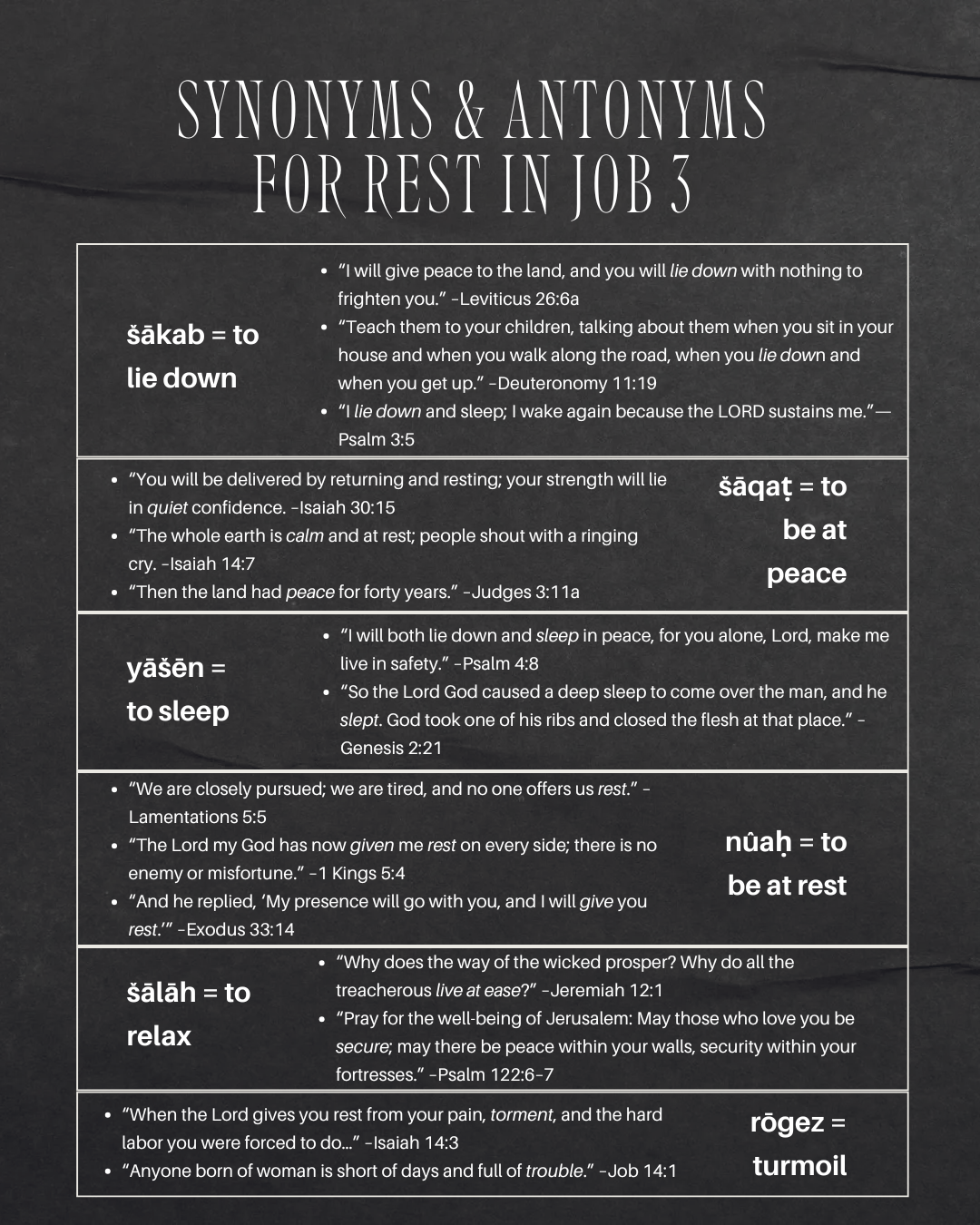
Job curses the day he was born and then laments his own existence in turmoil. This kind of existential depression will cause Job to seek new ways of viewing God beyond the common cultural norms, but in this chapter, we see the true heart of depression as a search for rest. Job asks, “Why is this happening to me?” but what he really seeks is not the answer to this question, rather relief from his suffering. Throughout the book of Job, Job will unapologetically tell God (and his friends) how he feels. He is as brutally honest as he is in chapter 3. This does not necessarily bring Job relief, but it will prepare his heart for what God wants to teach him next. (We will see these truths over the next few lessons.)
So today, amid your depression, if you feel like God has only given you life for you to experience pain and suffering, let Him know how you are feeling. God is not surprised by the depth of human emotion, and He can take the full brunt of it directed at Him. After you have been brutally honest with God, watch and wait for what He wants to teach you next. In His Presence, we can find that rest that we so desperately seek. Jesus says to us today, “Come to me, all of you who are weary and burdened, and I will give you rest” (Matthew 11:28).