A Picture of Job
One of the most well-known Biblical stories about depression has to be the story of Job, a man who lost much but refused to curse God, a man who steadfastly upheld his innocence even when accused by his friends of sin, and a man who was humbled by a direct response from the LORD. Let’s look at how Scripture characterizes Job:
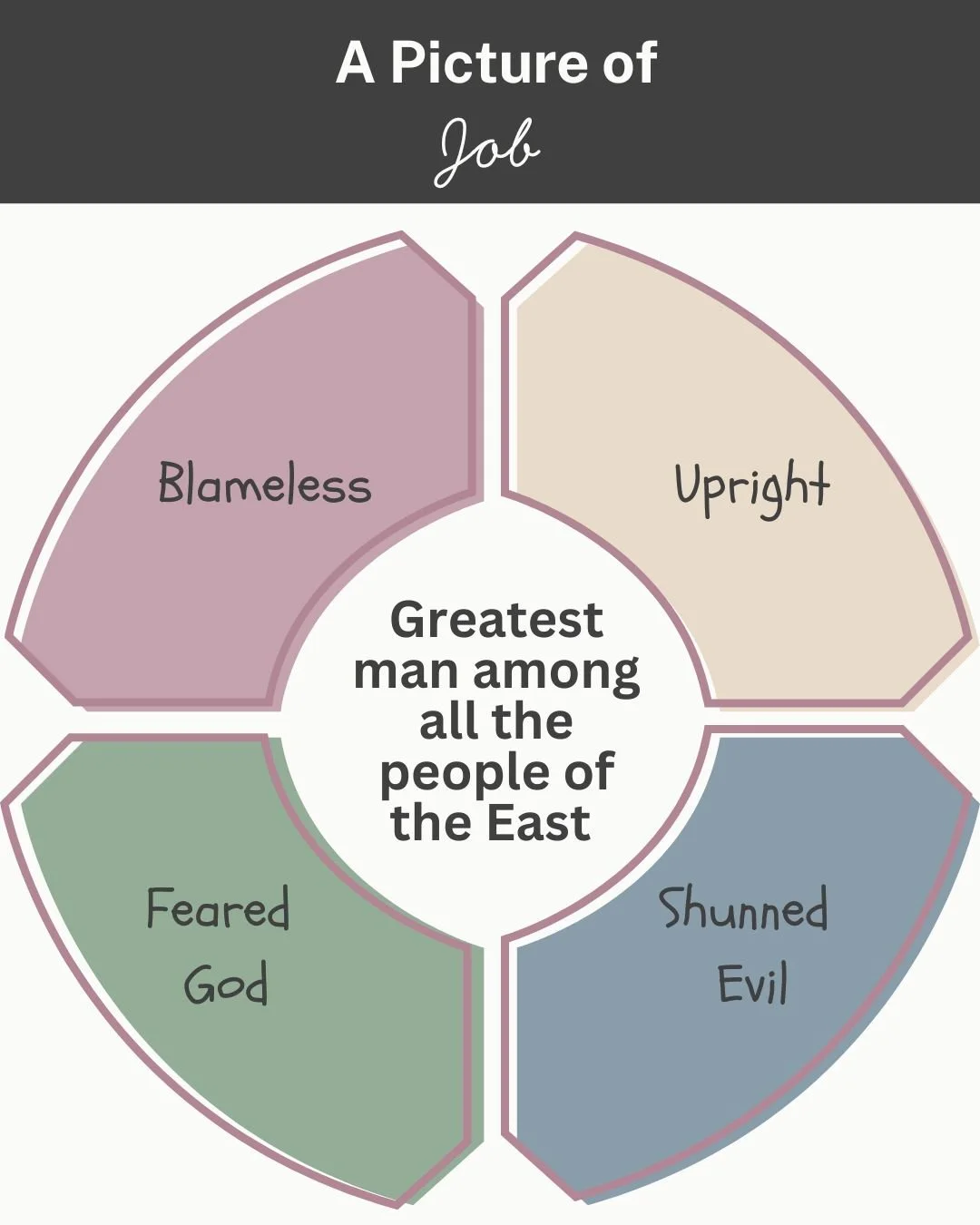
“There was a man in the country of Uz named Job. He was a man of complete integrity, who feared God and turned away from evil. He had seven sons and three daughters. His estate included seven thousand sheep and goats, three thousand camels, five hundred yoke of oxen, five hundred female donkeys, and a very large number of servants. Job was the greatest man among all the people of the east.”
Usually, a Biblical patriarch is introduced with a genealogy. However, Job is merely placed on the scene with no fanfare or even a reference to what time he lived in. Job is important not because of who he was related to but because of what he will experience. Therefore, Job represents anyone who suffers.[1]
The CSB characterizes Job as a man of “complete integrity” (Job 1:1). The ESV translates this phrase more literally: “blameless and upright.” What did the author of Job intend for us to know about Job from this first sentence?
The word for blameless used here is the Hebrew word tām, which means “complete, morally innocent, having integrity.”[2] Let’s take a look at some of the places this root appears in the Book of Job:
In parallel to fear of the Lord: Job 4:6—Is not your fear of God your confidence, and the integrity of your ways your hope?
In conjunction with righteousness:
Job 27:5-6—Far be it from me to say that you are right; till I die I will not put away my integrity from me. I hold fast my righteousness and will not let it go; my heart does not reproach me for any of my days.
Job 12:4—I am a laughingstock to my friends, by calling on God, who answers me. The righteous and blameless man is a laughingstock.
Job 22:3--Is it any pleasure to the Almighty if you are in the right, or is it gain to him if you make your ways blameless? (ESV)
In contrast to falsehood and deceit: Job 31:5-6—If I have walked in falsehood or my foot has rushed to deceit, let God weigh me on accurate scales, and he will recognize my integrity.
As evidence of God’s favor: Job 8:20—Look, God does not reject a person of integrity, and he will not support evildoers.
The KJV translates tām as “perfect.” This interpretation can give the impression that Job was sinless. A more accurate translation of tām as “blameless” characterizes Job as someone who pursued God wholeheartedly and had integrity before Him.[3] This idea emphasizes Job’s purity and righteousness in God’s sight.

The word for upright used here is the Hebrew word yāsār, which means “straightforward, just, upright.”[4] Let’s take a look at some of the places this root appears in Scripture:
In conjunction with purity:
Job 8:5-6—But if you earnestly seek God and ask the Almighty for mercy, if you are pure and upright, then he will move even now on your behalf and restore the home where your righteousness dwells.
Proverbs 20:11—Even a young man is known by his actions—by whether his behavior is pure and upright.
In parallel with innocence (being free from guilt):
Job 4:7—Consider: Who has perished when he was innocent? Where have the honest been destroyed?
Proverbs 21:8—A guilty one’s conduct is crooked, but the behavior of the innocent is upright.
Synonymously with being good or reliable: [5]
1 Samuel 29:6—So Achish summoned David and told him, “As the Lord lives, you are an honorable man. I think it is good to have you fighting in this unit with me, because I have found no fault in you from the day you came to me until today. But the leaders don’t think you are reliable.”
1 Samuel 12:23—As for me, I vow that I will not sin against the Lord by ceasing to pray for you. I will teach you the good and right way.
In relation to being honest or sincere:
Cf. Job 4:7 above
Job 6:25—How painful honest words can be! But what does your rebuke prove?
Job 33:3—My words come from my upright heart, and my lips speak with sincerity what they know.
Yāsār was commonly used in Wisdom Literature to refer to the upright among God’s people as opposed to the wicked. The author of Job uses it here to assure the reader which side Job falls into, laying the foundation for his argument that suffering does not always arise from someone’s wrongdoing. Yāsār characterized Job’s relationship with other people.[6]He did what was right with his wealth and prestige rather than taking advantage of the poor and oppressed (cf. Job 31:13-23).
These two concepts come together to express the CSB translation that describes Job as a man of “complete integrity.” He was both blameless before God and upright among men. He was wholly and completely just toward others so that before God’s righteousness, he could stand unashamed. See how these ideas build on each other in these other verses where these two terms are used together to describe a righteous person:
What God says about Job that confirms what the narrator told us about him in 1:1: Job 1:8—Then the Lord said to Satan, “Have you considered my servant Job? No one else on earth is like him, a man of perfect integrity, who fears God and turns away from evil.”
And God confirms again about Job: Job 2:3—Then the Lord said to Satan, “Have you considered my servant Job? No one else on earth is like him, a man of perfect integrity, who fears God and turns away from evil. He still retains his integrity, even though you incited me against him, to destroy him for no good reason.”
Proverbs 29:10—Bloodthirsty men hate one who is blameless and seek the life of the upright. (ESV)
Psalm 37:37—Watch the blameless and observe the upright, for the person of peace will have a future.
Psalm 25:21—May integrity and uprightness preserve me, for I wait for you.
Finally, Scripture affirms that Job had a devout faith because he feared God and shunned evil—i.e., he loved the LORD and avoided even the appearance of evil in his life.[7] These two phrases again summarize Job’s relationship with God and his relationship with others. So Scripture can refer to Job as “the greatest man among all the people of the east.” He was an important and distinguished man[8] because of his relationship with God and how he treated others.
Few of us would use the terms blameless and upright to describe ourselves. While we might claim to fear God, we might be hesitant to say that we shun evil all the time. However, it is important to remember that God sees us as blameless saints because we have been cleansed by the blood of Christ Jesus. Colossians 1:21-23 says, “Once you were alienated and hostile in your minds as expressed in your evil actions.But now he has reconciled you by his physical body through his death, to present you holy, faultless, and blameless before him—if indeed you remain grounded and steadfast in the faith and are not shifted away from the hope of the gospel that you heard.” We are blameless before God when we stay grounded and steadfast in the faith founded on the Gospel we have heard and believed.
Job’s characterization underlines the truth that even those of strong faith suffer—even we ourselves can suffer. As we will see, a strong faith does not exempt us from feeling despair, from experiencing loss, or from a justified anger toward God. Being depressed did not change Job’s standing before God as a blameless and upright man. Likewise for us, being depressed does not separate us from God’s favor.
________________________
[1] John E. Hartley, The Book of Job, The New International Commentary on the Old Testament (Grand Rapids, MI: Wm. B. Eerdmans Publishing Co., 1988), 66–67.
[2] Francis Brown, Samuel Rolles Driver, and Charles Augustus Briggs, Enhanced Brown-Driver-Briggs Hebrew and English Lexicon (Oxford: Clarendon Press, 1977), 1070–1071.
[3] John E. Hartley, The Book of Job, 67. Biblical Studies Press. The NET Bible, 804.
[4] Francis Brown, Samuel Rolles Driver, and Charles Augustus Briggs, Enhanced Brown-Driver-Briggs Hebrew and English Lexicon, 449.
[5] In these verses, the Hebrew word alternatively translated good or reliable is the same word.
[6] Biblical Studies Press. The NET Bible. Second Edition. Denmark: Thomas Nelson, 2019, 804.
[7] John E. Hartley, The Book of Job, 67.
[8] Francis Brown, Samuel Rolles Driver, and Charles Augustus Briggs, Enhanced Brown-Driver-Briggs Hebrew and English Lexicon, 153.
