
Why is This Happening to Me?
The first two chapters of Job give us the large-scale scope of what is happening to Job: He is stuck in a cosmic tug-of-war between God and the Accuser, Satan. Satan argues that God has blessed Job, and this is the reason he is righteous. If God would take away everything that Job owns, he would curse God. Job loses his livestock, his servants, and his children, but still does not blame God or sin in any way (Job 1:22). Satan then argues that if God were to strike Job’s flesh, this would surely cause him to curse God, so God allows Job to be infected with terrible boils from the soles of his feet to the top of his head (Job 2:7). Amid all this happening, Job has no knowledge of the machinations behind the scenes. His only reality is the pain and suffering he is experiencing. His wife urges him to curse God and die (Job 2:9). His friends sit silently with him for seven days and seven nights (Job 2:13). But Job must eventually give voice to his anguish.

The first two chapters of Job give us the large-scale scope of what is happening to Job: He is stuck in a cosmic tug-of-war between God and the Accuser, Satan. Satan argues that God has blessed Job, and this is the reason he is righteous. If God would take away everything that Job owns, he would curse God. Job loses his livestock, his servants, and his children, but still does not blame God or sin in any way (Job 1:22). Satan then argues that if God were to strike Job’s flesh, this would surely cause him to curse God, so God allows Job to be infected with terrible boils from the soles of his feet to the top of his head (Job 2:7). Amid all this happening, Job has no knowledge of the machinations behind the scenes. His only reality is the pain and suffering he is experiencing. His wife urges him to curse God and die (Job 2:9). His friends sit silently with him for seven days and seven nights (Job 2:13). But Job must eventually give voice to his anguish.
In chapter 3, Job begins to speak and what he says is shocking. He doesn’t curse God as Satan predicted or even despair of life like Elijah did. Job curses the day he was born. If only God had not created that day, he would be spared this suffering:
“After this, Job began to speak and cursed the day he was born. He said:
‘May the day I was born perish,
and the night that said,
“A boy is conceived.”
If only that day had turned to darkness!
May God above not care about it,
or light shine on it.
May darkness and gloom reclaim it,
and a cloud settle over it.
May what darkens the day terrify it.
If only darkness had taken that night away!
May it not appear among the days of the year
or be listed in the calendar.
Yes, may that night be barren;
may no joyful shout be heard in it.
Let those who curse days
condemn it,
those who are ready to rouse Leviathan.
May its morning stars grow dark.
May it wait for daylight but have none;
may it not see the breaking of dawn.
For that night did not shut
the doors of my mother’s womb,
and hide sorrow from my eyes.’”
Notice how many times the words “may” or “let” show up in Job’s curse. These appearances indicate a specific mood of the Hebrew verb that indicates a wish or suggestion as a command (“Let it be...”). Job’s use of the jussive form here is meant to evoke the creation account where God’s wishes became reality (e.g., “Let there be light,” etc.). Job wishes that he could undo the creation of the day he was born.[1]
Then Job raises the rhetorical situation that if he couldn’t undo the day of his birth, maybe he could have been stillborn instead:
“Why was I not stillborn;
why didn’t I die as I came from the womb?
Why did the knees receive me,
and why were there breasts for me to nurse?
Now I would certainly be lying down in peace;
I would be asleep.
Then I would be at rest
with the kings and counselors of the earth,
who rebuilt ruined cities for themselves,
or with princes who had gold,
who filled their houses with silver.
Or why was I not hidden like a miscarried child,
like infants who never see daylight?
There the wicked cease to make trouble,
and there the weary find rest.
The captives are completely at rest;
they do not hear a taskmaster’s voice.
Both small and great are there,
and the slave is set free from his master.”
These verses reveal the true reason why Job has issued this curse against the day he was born. For if he were dead, he would be at rest. Verse 13 summarizes his point with 4 different synonyms for rest used in one verse: to lie down (šākab), to be at peace (šāqaṭ), to sleep (yāšēn), and to be at rest (nûaḥ). Job longs for freedom from his suffering, and he knows that freedom can only truly be found in death.[2]
Job concludes with a lament. Why is this happening to him? Why was life given to someone only for him to experience misery?
“Why is light given to one burdened with grief,
and life to those whose existence is bitter,
who wait for death, but it does not come,
and search for it more than for hidden treasure,
who are filled with much joy
and are glad when they reach the grave?
Why is life given to a man whose path is hidden,
whom God has hedged in?
I sigh when food is put before me,
and my groans pour out like water.
For the thing I feared has overtaken me,
and what I dreaded has happened to me.
I cannot relax or be calm;
I have no rest, for turmoil has come.”
Why was life given to a man whose destiny is clouded, whose present plight has no purpose? While Satan might say that God hedged Job in to keep him in prosperity (Job 1:10), Job declares God has hedged him in to entrap him in misery. While God got to rest on the seventh day of creation, Job is left where he cannot relax.[3] Here again in verse 26, we see a threefold repetition of rest synonyms—relax (šālāh), be calm (šāqaṭ), and rest (nûaḥ)—but these end in their opposite: turmoil (rōgez).
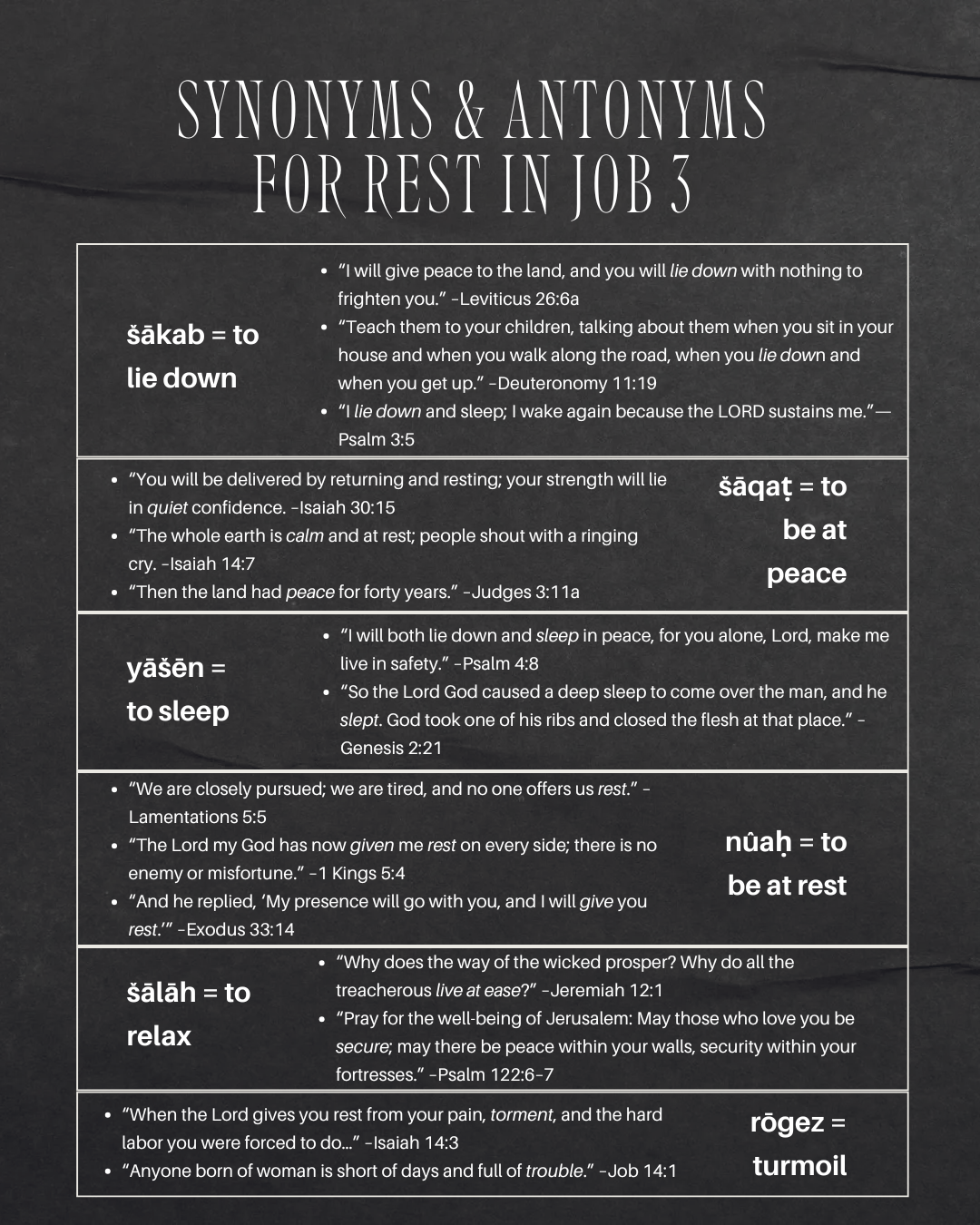
Job curses the day he was born and then laments his own existence in turmoil. This kind of existential depression will cause Job to seek new ways of viewing God beyond the common cultural norms, but in this chapter, we see the true heart of depression as a search for rest. Job asks, “Why is this happening to me?” but what he really seeks is not the answer to this question, rather relief from his suffering. Throughout the book of Job, Job will unapologetically tell God (and his friends) how he feels. He is as brutally honest as he is in chapter 3. This does not necessarily bring Job relief, but it will prepare his heart for what God wants to teach him next. (We will see these truths over the next few lessons.)
So today, amid your depression, if you feel like God has only given you life for you to experience pain and suffering, let Him know how you are feeling. God is not surprised by the depth of human emotion, and He can take the full brunt of it directed at Him. After you have been brutally honest with God, watch and wait for what He wants to teach you next. In His Presence, we can find that rest that we so desperately seek. Jesus says to us today, “Come to me, all of you who are weary and burdened, and I will give you rest” (Matthew 11:28).

A Picture of Job
One of the most well-known Biblical stories about depression has to be the story of Job, a man who lost much but refused to curse God, a man who steadfastly upheld his innocence even when accused by his friends of sin, and a man who was humbled by a direct response from the LORD. Usually, a Biblical patriarch is introduced with a genealogy. However, Job is merely placed on the scene with no fanfare or even a reference to what time he lived in. Job is important not because of who he was related to but because of what he will experience. Therefore, Job represents anyone who suffers. The CSB characterizes Job as a man of “complete integrity” (Job 1:1). The ESV translates this phrase more literally: “blameless and upright.” What did the author of Job intend for us to know about Job from this first sentence?
One of the most well-known Biblical stories about depression has to be the story of Job, a man who lost much but refused to curse God, a man who steadfastly upheld his innocence even when accused by his friends of sin, and a man who was humbled by a direct response from the LORD. Let’s look at how Scripture characterizes Job:
“There was a man in the country of Uz named Job. He was a man of complete integrity, who feared God and turned away from evil. He had seven sons and three daughters. His estate included seven thousand sheep and goats, three thousand camels, five hundred yoke of oxen, five hundred female donkeys, and a very large number of servants. Job was the greatest man among all the people of the east.”
Usually, a Biblical patriarch is introduced with a genealogy. However, Job is merely placed on the scene with no fanfare or even a reference to what time he lived in. Job is important not because of who he was related to but because of what he will experience. Therefore, Job represents anyone who suffers.[1]
The CSB characterizes Job as a man of “complete integrity” (Job 1:1). The ESV translates this phrase more literally: “blameless and upright.” What did the author of Job intend for us to know about Job from this first sentence?
The word for blameless used here is the Hebrew word tām, which means “complete, morally innocent, having integrity.”[2] Let’s take a look at some of the places this root appears in the Book of Job:
In parallel to fear of the Lord: Job 4:6—Is not your fear of God your confidence, and the integrity of your ways your hope?
In conjunction with righteousness:
Job 27:5-6—Far be it from me to say that you are right; till I die I will not put away my integrity from me. I hold fast my righteousness and will not let it go; my heart does not reproach me for any of my days.
Job 12:4—I am a laughingstock to my friends, by calling on God, who answers me. The righteous and blameless man is a laughingstock.
Job 22:3--Is it any pleasure to the Almighty if you are in the right, or is it gain to him if you make your ways blameless? (ESV)
In contrast to falsehood and deceit: Job 31:5-6—If I have walked in falsehood or my foot has rushed to deceit, let God weigh me on accurate scales, and he will recognize my integrity.
As evidence of God’s favor: Job 8:20—Look, God does not reject a person of integrity, and he will not support evildoers.
The KJV translates tām as “perfect.” This interpretation can give the impression that Job was sinless. A more accurate translation of tām as “blameless” characterizes Job as someone who pursued God wholeheartedly and had integrity before Him.[3] This idea emphasizes Job’s purity and righteousness in God’s sight.

The word for upright used here is the Hebrew word yāsār, which means “straightforward, just, upright.”[4] Let’s take a look at some of the places this root appears in Scripture:
In conjunction with purity:
Job 8:5-6—But if you earnestly seek God and ask the Almighty for mercy, if you are pure and upright, then he will move even now on your behalf and restore the home where your righteousness dwells.
Proverbs 20:11—Even a young man is known by his actions—by whether his behavior is pure and upright.
In parallel with innocence (being free from guilt):
Job 4:7—Consider: Who has perished when he was innocent? Where have the honest been destroyed?
Proverbs 21:8—A guilty one’s conduct is crooked, but the behavior of the innocent is upright.
Synonymously with being good or reliable: [5]
1 Samuel 29:6—So Achish summoned David and told him, “As the Lord lives, you are an honorable man. I think it is good to have you fighting in this unit with me, because I have found no fault in you from the day you came to me until today. But the leaders don’t think you are reliable.”
1 Samuel 12:23—As for me, I vow that I will not sin against the Lord by ceasing to pray for you. I will teach you the good and right way.
In relation to being honest or sincere:
Cf. Job 4:7 above
Job 6:25—How painful honest words can be! But what does your rebuke prove?
Job 33:3—My words come from my upright heart, and my lips speak with sincerity what they know.
Yāsār was commonly used in Wisdom Literature to refer to the upright among God’s people as opposed to the wicked. The author of Job uses it here to assure the reader which side Job falls into, laying the foundation for his argument that suffering does not always arise from someone’s wrongdoing. Yāsār characterized Job’s relationship with other people.[6]He did what was right with his wealth and prestige rather than taking advantage of the poor and oppressed (cf. Job 31:13-23).
These two concepts come together to express the CSB translation that describes Job as a man of “complete integrity.” He was both blameless before God and upright among men. He was wholly and completely just toward others so that before God’s righteousness, he could stand unashamed. See how these ideas build on each other in these other verses where these two terms are used together to describe a righteous person:
What God says about Job that confirms what the narrator told us about him in 1:1: Job 1:8—Then the Lord said to Satan, “Have you considered my servant Job? No one else on earth is like him, a man of perfect integrity, who fears God and turns away from evil.”
And God confirms again about Job: Job 2:3—Then the Lord said to Satan, “Have you considered my servant Job? No one else on earth is like him, a man of perfect integrity, who fears God and turns away from evil. He still retains his integrity, even though you incited me against him, to destroy him for no good reason.”
Proverbs 29:10—Bloodthirsty men hate one who is blameless and seek the life of the upright. (ESV)
Psalm 37:37—Watch the blameless and observe the upright, for the person of peace will have a future.
Psalm 25:21—May integrity and uprightness preserve me, for I wait for you.
Finally, Scripture affirms that Job had a devout faith because he feared God and shunned evil—i.e., he loved the LORD and avoided even the appearance of evil in his life.[7] These two phrases again summarize Job’s relationship with God and his relationship with others. So Scripture can refer to Job as “the greatest man among all the people of the east.” He was an important and distinguished man[8] because of his relationship with God and how he treated others.

Few of us would use the terms blameless and upright to describe ourselves. While we might claim to fear God, we might be hesitant to say that we shun evil all the time. However, it is important to remember that God sees us as blameless saints because we have been cleansed by the blood of Christ Jesus. Colossians 1:21-23 says, “Once you were alienated and hostile in your minds as expressed in your evil actions.But now he has reconciled you by his physical body through his death, to present you holy, faultless, and blameless before him—if indeed you remain grounded and steadfast in the faith and are not shifted away from the hope of the gospel that you heard.” We are blameless before God when we stay grounded and steadfast in the faith founded on the Gospel we have heard and believed.
Job’s characterization underlines the truth that even those of strong faith suffer—even we ourselves can suffer. As we will see, a strong faith does not exempt us from feeling despair, from experiencing loss, or from a justified anger toward God. Being depressed did not change Job’s standing before God as a blameless and upright man. Likewise for us, being depressed does not separate us from God’s favor.
________________________
[1] John E. Hartley, The Book of Job, The New International Commentary on the Old Testament (Grand Rapids, MI: Wm. B. Eerdmans Publishing Co., 1988), 66–67.
[2] Francis Brown, Samuel Rolles Driver, and Charles Augustus Briggs, Enhanced Brown-Driver-Briggs Hebrew and English Lexicon (Oxford: Clarendon Press, 1977), 1070–1071.
[3] John E. Hartley, The Book of Job, 67. Biblical Studies Press. The NET Bible, 804.
[4] Francis Brown, Samuel Rolles Driver, and Charles Augustus Briggs, Enhanced Brown-Driver-Briggs Hebrew and English Lexicon, 449.
[5] In these verses, the Hebrew word alternatively translated good or reliable is the same word.
[6] Biblical Studies Press. The NET Bible. Second Edition. Denmark: Thomas Nelson, 2019, 804.
[7] John E. Hartley, The Book of Job, 67.
[8] Francis Brown, Samuel Rolles Driver, and Charles Augustus Briggs, Enhanced Brown-Driver-Briggs Hebrew and English Lexicon, 153.

The Nearness of God’s Presence
God has two more commands for Elijah: “Go out and stand.” He calls Elijah out of the cave where he has spent the night—again a symbolic as well as literal call to change like “Arise and eat.” But this time, God doesn’t command a doing but a being: “stand on the mountain.” Mountaintops were often where God met His people in the Old Testament. In fact, Mount Horeb where Elijah ended up is the same Mount Sinai where God gave Moses the Ten Commandments in Exodus 19 and 34. This mountain in particular was primed to be a place of revelation. But Elijah’s role is merely to stand—to stay put. Where? In the Lord’s Presence. God would do the revealing while Elijah would do the standing as God’s Presence came down.
Last time we looked at how God’s questions led Elijah to genuinely express his feelings and even challenge the validity of those feelings. God did not just ask Elijah questions. He appeared to Him in a new way:
“Then he said, ‘Go out and stand on the mountain in the Lord’s presence.’
“At that moment, the Lord passed by. A great and mighty wind was tearing at the mountains and was shattering cliffs before the Lord, but the Lord was not in the wind. After the wind there was an earthquake, but the Lord was not in the earthquake. After the earthquake there was a fire, but the Lord was not in the fire. And after the fire there was a voice, a soft whisper. When Elijah heard it, he wrapped his face in his mantle and went out and stood at the entrance of the cave.” ”
God has two more commands for Elijah: “Go out and stand.” He calls Elijah out of the cave where he has spent the night—again a symbolic as well as literal call to change like “Arise and eat.” But this time, God doesn’t command a doing but a being: “stand on the mountain.” Mountaintops were often where God met His people in the Old Testament. In fact, Mount Horeb where Elijah ended up is the same Mount Sinai where God gave Moses the Ten Commandments in Exodus 19 and 34. This mountain in particular was primed to be a place of revelation. But Elijah’s role is merely to stand—to stay put. Where? In the Lord’s Presence. God would do the revealing while Elijah would do the standing as God’s Presence came down.
In 1 Kings 18, Elijah experienced an awesome display of God’s power and presence when He sent down fire from heaven upon the sacrifice at Mount Carmel. Most likely, Elijah expected some similar experience of God’s Presence. Surely the Lord would be found in the great wind, the earthquake, or the fire. These methods are the ways God had revealed Himself in the past. But isn’t it so like the Lord to do something so much larger and so much quieter than we expect?
Elijah hears God’s Presence in the sound of a soft whisper. The Hebrew here is difficult to translate, but some translations call it a still, small voice. Essentially, it means the sound of total silence.[1] Psalm 107:29 uses the same word to describe how the Lord “stilled the storm to a whisper.” Instead of something dramatic and overt, God’s Presence comes to Elijah in the stillness and silence after a storm. How often I have prayed for God to still the storm of depressive thoughts. How often I have sat in the silence feeling alone in my suffering. It is here God would have me stay—in the stillness where His Presence can come through.
The text does not specifically say that God’s Presence was in the silence; however, Elijah’s reaction to this still, small voice implies that He had experienced the Lord’s presence. Elijah wraps his face in his mantle and returns to the entrance of the cave where he started. As we saw in the last lesson, this experience of God’s Presence does not immediately change Elijah’s feelings. He responds in the same manner when God asks him what he is doing there. However, Elijah’s response to hide his face does indicate an acknowledgement of God’s awesome presence.

Depression often lies to us in order to have us believe that our God is small. Too weak to heal us. Too uninterested to change our pain. Believing these lies can cause irreverence in how we relate to God. For me, this concept proved true in my search for pleasure in the world rather than in a deeper relationship with God. The truth of my irreverence came to a head when I went to a residential facility to deal with my depression. I had to give up every crutch I was clinging to and I wasn’t sure I was going to survive without the counterfeit pleasure those idols provided. I had a vision of myself before a giant wall of depression, and I despaired of ever finding a way over that wall. That’s when I recognized a Presence behind the wall. As large as that wall was in front of me, He was that much larger than my wall. God gave me a new perspective in that vision—a perspective that proved how much greater He was than my problems.
I think this perspective shift is similar to what Elijah experienced at Mount Horeb. While it didn’t change his depressive feelings, Elijah could no longer deny God’s nearness or God’s care for him. Elijah was faced with his own unbelief that had limited God and knew the only appropriate response was to hide his face in repentance. When God asked him a second time what he was doing there, Elijah could only answer as he had done before, but this time those excuses did not come from a place of irreverence but from a broken and contrite heart that despaired of changing himself.
Perhaps the experience of God’s Presence is not a comfortable one for you right now. It might involve facing some crutches you’ve leaned upon instead of the Lord. It might involve facing your own unbelief that questions the goodness of God in your circumstances. But once you let God’s Presence come near, however He ordains it to appear, you will know the truth about who God is for you in this moment. Be on the lookout for God’s Presence. Heed His calling to come out and stand in His Presence. Embrace the discomfort of facing your own sin. And allow the truth of God’s Presence to expand your belief.
[1] Gary Inrig, I & II Kings, edited by Max Anders, Vol. 7, Holman Old Testament Commentary (Nashville, TN: Holman, 2003).

God’s Questions
God’s questions invited a place where Elijah could freely express his feelings, but they also called out the irrational beliefs that held him captive and redirected him toward the truth. When I struggle with depression, I am bombarded by thoughts like “I’m not good enough. Everyone would be better without you.” “It doesn’t matter what I do. Things will stay like this forever.” “I am alone in this. There is no one to help me.” But I have found the truth in God’s Word that tells me I am chosen and adopted by God. The hope of the Gospel rests on the life-changing power of the Spirit not on my own strength. And God is my ever-present help in trouble, even when the rest of the world abandons me.
What is your answer to God’s question today? Why are you here? Pour it all out to Him—the unvarnished truth of your dark thoughts. Then allow Him to redirect you with the truth of His Word. Challenge those irrational thoughts with the reality God has shown you. His redirection will lead you out of the mire of your own thoughts and into the freedom of following Him with abandon.
Last time, we talked about God’s instruction to Elijah to arise and eat. This prescription for depression showed us how obedience in the ordinary leads to strength for the journey ahead. What were God’s next words to Elijah?
“And the word of the Lord came to him: ‘What are you doing here, Elijah?’
“He replied, ‘I have been very zealous for the Lord God Almighty. The Israelites have rejected your covenant, torn down your altars, and put your prophets to death with the sword. I am the only one left, and now they are trying to kill me too.’ ”
God does not ask questions in Scripture because He is seeking an answer that He does not already know. He asks questions to get us to recognize and verbalize something about ourselves or something about Him. In this passage, God is not accusing Elijah of being where he is not supposed to be nor is He second-guessing Elijah’s choices. He is giving Elijah an opening to express his true feelings. It is worth it to compare the question God asked Elijah with questions He asks elsewhere in Scripture so that we can determine what kind of question God is asking here.
While these categories are fluid and not mutually exclusive, God has several different purposes for His questions:
-
God often asks questions to convict us of our sin or to help us recognize where we are in the wrong. In the Garden, God asked Adam and Eve, “Where are you?” (Genesis 3:1) and “Who told you that you were naked?” (Genesis 3:10). After Cain killed his brother, God asked him, “What have you done?” (Genesis 4:8-10). When Job questioned God’s plan for his suffering, God asked him, “Where were you when I established the earth?” (Job 38:4). When Jonah was upset that God had forgiven the Ninevites, God asked him, “Is it right for you to be angry?” (Jonah 4:4). When the disciples feared for their lives and begged Jesus to save them during the storm, Jesus calmed the wind and waves and asked them, “Why are you afraid, you of little faith?” (Matthew 8:26). On the road to Damascus, Jesus asked Paul, “Why are you persecuting Me?” (Acts 9:4).
-
God asks questions to call us to a new path. When Hagar ran from her mistress, God asked her, “Where have you come from and where are you going?” (Genesis 16:7). When Moses asked for a sign to give to the Israelites so they would believe, God asked him, “What is that in your hand?” (Exodus 4:2). When He had a message for Isaiah to proclaim to God’s people, God asked him, “Whom shall I send? Who will go for us?” (Isaiah 6:8). To commission Peter to feed His sheep, Jesus asked him, “Do you love Me?” (John 21:15-17).
-
God asks questions to spur us on to greater faith by realizing something about ourselves or something about Him. When Jacob was about to receive a new name from the LORD, God asked him, “What is your name?” (Genesis 32:27). On the cusp of restoring Israel, God asked Ezekiel, “Son of Man, can these bones live?” (Ezekiel 37:3). Jesus asked His disciples, “Who do you say that I am?” (Matthew 16:15). At the pool of Bethesda, Jesus asked the lame man, “Do you want to get well?” (John 5:6). When Jesus realized two of John the Baptist’s disciples were following him, He turned and asked them, “What are you looking for?” (John 1:38) At the tomb, Jesus asked Mary Magdalene, “Why are you crying?” (John 20:13). When Peter began to drown after walking on water, Jesus reached down and asked him, “You of little faith, why did you doubt?” (Matthew 14:31).

So what is the purpose for God’s question to Elijah? The LORD had led Elijah through the wilderness to this mountain, but Elijah needed to realize how he ended up there. Elijah’s response is to justify why he is feeling depressed, but God is seeking to redirect Elijah’s focus. We will see this in God’s revelation of His presence in the still, small voice. But afterward, God asks the same question again, and Elijah gives the same answer.
“Then a voice said to him, ‘What are you doing here, Elijah?’
“He replied, ‘I have been very zealous for the Lord God Almighty. The Israelites have rejected your covenant, torn down your altars, and put your prophets to death with the sword. I am the only one left, and now they are trying to kill me too.’ ”
Notice that God never refutes Elijah’s first two statements. He knows Elijah has been zealous for Him and He knows there are many who have worshipped Ba’al and agree with their king in attempting to put Elijah to death. However, God does find fault with his last statement that he is the only one left.
First, God tells Elijah his work is not yet done. God refutes Elijah’s earlier claim that he has made no more difference than his prophetic ancestors had (1 Kings 19:2). Instead of giving up, he has to go back the way he came. Maybe Elijah got discouraged because he thought this was all God could do when God was just getting started. How often does depression lie to us that this is all there is—that there will never be any change that makes a difference?
Second, He tells Elijah to anoint three people who will be crucial in defeating Elijah’s enemies, answering Elijah’s complaints with reinforcements: Hazael in Aram, Jehu in Israel, and Elisha in his prophetic circle. Although Elijah might not see the fruit of this work, those who follow him will. In fact, Elijah only directly appoints Elisha who performs the other two anointings in Elijah’s authority (2 Kings 9). And it is Hazael and Jehu who destroy Ahab’s family and the last vestiges of Ba’al worship in this generation of Israel. God speaks to Elijah’s despair with the promise that He will complete His work; Elijah’s zeal will be satisfied, but he himself will only be part of the plan.[1] Depression often robs us of perspective, making our thoughts and feelings larger than the big picture God sees. What if the purpose of your life was not all up to you to fulfill? What if God’s plans go far beyond what you are able to do in this moment?
Finally, He disproves Elijah’s declaration that he is the last one left. There are still 7,000 in Israel who have not bent the knee to Ba’al. While depression had convinced Elijah he was alone, God reminded him of the truth: there were many still on his side. Elijah has even discounted the hundred prophets that Obadiah had saved while he was in hiding from Ahab (1 Kings 18:4, 13). How often does the isolation of depression convince us we are alone when we are surrounded by a great cloud of witnesses in the Church both past and present who fight with us?

What are some of the irrational beliefs you’ve told yourself? What is the reality that God is trying to teach you instead? How can you replace your thoughts with God’s truth?
God’s questions invited a place where Elijah could freely express his feelings, but they also called out the irrational beliefs that held him captive and redirected him toward the truth. When I struggle with depression, I am bombarded by thoughts like “I’m not good enough. Everyone would be better without you.” “It doesn’t matter what I do. Things will stay like this forever.” “I am alone in this. There is no one to help me.” But I have found the truth in God’s Word that tells me I am chosen and adopted by God. The hope of the Gospel rests on the life-changing power of the Spirit not on my own strength. And God is my ever-present help in trouble, even when the rest of the world abandons me.
What is your answer to God’s question today? Why are you here? Pour it all out to Him—the unvarnished truth of your dark thoughts. Then allow Him to redirect you with the truth of His Word. Challenge those irrational thoughts with the reality God has shown you. His redirection will lead you out of the mire of your own thoughts and into the freedom of following Him with abandon. Next time, we will see how the act of being honest with God can free us to experience His Presence.
[1] Gary Inrig, I & II Kings, edited by Max Anders, Vol. 7, Holman Old Testament Commentary (Nashville, TN: Holman, 2003).

A Lack of Faith?
As believers, we often see a depressed Christian, or even an unhappy Christian, as an oxymoron. There must be something lacking in their spiritual life. When I have voiced my own struggles with depression, other well-meaning Christians have asked, “But doesn’t Scripture tell us to be joyful in the Lord?” This kind of reminder comes from a reductive explanation for the root cause of depression: If only you had more faith, you wouldn’t feel so depressed. It is easy to use this thinking on ourselves to conclude that if we are depressed, we just don’t believe enough in God’s power to heal us. But a lack of faith is not the cause of depression for those in Scripture. In previous weeks, we picked up the story of Elijah at his worst suicidal moment, but how did he find himself in this position? Was it because he did not have enough faith? Was there some major weakness or deficiency in his faith-walk that led him to struggle with depression?
As believers, we often see a depressed Christian, or even an unhappy Christian, as an oxymoron. There must be something lacking in their spiritual life. When I have voiced my own struggles with depression, other well-meaning Christians have asked, “But doesn’t Scripture tell us to be joyful in the Lord?” This kind of reminder comes from a reductive explanation for the root cause of depression: If only you had more faith, you wouldn’t feel so depressed. It is easy to use this thinking on ourselves to conclude that if we are depressed, we just don’t believe enough in God’s power to heal us. But a lack of faith is not the cause of depression for those in Scripture. In previous weeks, we picked up the story of Elijah at his worst suicidal moment, but how did he find himself in this position? Was it because he did not have enough faith? Was there some major weakness or deficiency in his faith-walk that led him to struggle with depression?

Elijah’s story appears in the book of First Kings. First and Second Kings are the chronicles of the kings of Israel that came after David. First Kings begins with the reign of Solomon, David’s son. Elijah’s story begins several hundred years after Solomon. In the intervening years, the united nation of Israel that Solomon ruled has been divided into two nations: Judah in the south and Israel in the north (not to be confused with the united nation that encompassed the geography of both Judah and Israel). Now the nation of Judah housed the temple in Jerusalem so Jeroboam, Israel’s first king, made two golden calves and proclaimed them to be Israel’s gods. He set up altars for these calves in Bethel and Dan (cf. 1 Kings 12:25-30). As the Bible so succinctly puts it, “this led to sin.” Even though Israel was founded upon this idolatry, Judah had its own kings that led their people further into idolatry as well. The rest of First and Second Kings vacillate between recounting the reigns of Judah’s and then Israel’s kings. Some of these kings did what was right in the LORD’s sight; others led their people into service of false gods. The first time we meet Elijah is in the court of King Ahab:
“In the thirty-eighth year of Asa king of Judah, Ahab son of Omri became king of Israel, and he reigned in Samaria over Israel twenty-two years. Ahab son of Omri did more evil in the eyes of the Lord than any of those before him. He not only considered it trivial to commit the sins of Jeroboam son of Nebat, but he also married Jezebel daughter of Ethbaal king of the Sidonians, and began to serve Baal and worship him. He set up an altar for Baal in the temple of Baal that he built in Samaria. Ahab also made an Asherah pole and did more to arouse the anger of the Lord, the God of Israel, than did all the kings of Israel before him…
Now Elijah the Tishbite, from Tishbe in Gilead, said to Ahab, ‘As the Lord, the God of Israel, lives, whom I serve, there will be neither dew nor rain in the next few years except at my word.’
Then the word of the Lord came to Elijah: ‘Leave here, turn eastward and hide in the Kerith Ravine, east of the Jordan. You will drink from the brook, and I have directed the ravens to supply you with food there.’
So he did what the Lord had told him. He went to the Kerith Ravine, east of the Jordan, and stayed there. The ravens brought him bread and meat in the morning and bread and meat in the evening, and he drank from the brook. ”
The king of Israel during Elijah’s day was pretty much the worst. King Ahab didn’t just “unintentionally” perpetuate Jeroboam’s idolatry; he encouraged it. He built altars for Baal and Asherah poles to worship the Canaanite goddess, Asherah. During a time when Israel was questioning whether their God was truly active and alive, Elijah stood up to his king and proclaimed that he had heard from God. The God of Israel is alive. Elijah stands in His Presence, in the presence of the true King, and that King has the power to withhold rain from the nation of Israel until Elijah says otherwise. Elijah boldly took a stand against his culture to make this proclamation, and then he faithfully followed God’s directions to a place of refuge for him to reside during this famine. Because Elijah was obedient to God’s command, God provided food for him through His command of ravens. Already we see God intervening in Elijah’s life in powerful and miraculous ways to provide for his physical needs. And we see Elijah responding without hesitation or fear to do what God asks of him.
“After a long time, the word of the Lord came to Elijah in the third year: ‘Go and present yourself to Ahab. I will send rain on the surface of the land.’ So Elijah went to present himself to Ahab.
The famine was severe in Samaria. Ahab called for Obadiah, who was in charge of the palace. Obadiah was a man who greatly feared the Lord and took a hundred prophets and hid them, fifty men to a cave, and provided them with food and water when Jezebel slaughtered the Lord’s prophets. Ahab said to Obadiah, ‘Go throughout the land to every spring and to every wadi. Perhaps we’ll find grass so we can keep the horses and mules alive and not have to destroy any cattle.’ They divided the land between them in order to cover it. Ahab went one way by himself, and Obadiah went the other way by himself.
While Obadiah was walking along the road, Elijah suddenly met him. When Obadiah recognized him, he fell facedown and said, ‘Is it you, my lord Elijah?’
’It is I,’ he replied. ‘Go tell your lord, “Elijah is here!”‘
But Obadiah said, ‘What sin have I committed, that you are handing your servant over to Ahab to put me to death? As the Lord your God lives, there is no nation or kingdom where my lord has not sent someone to search for you. When they said, “He is not here,” he made that kingdom or nation swear they had not found you.
’Now you say, “Go tell your lord, ‘Elijah is here!’” But when I leave you, the Spirit of the Lord may carry you off to some place I don’t know. Then when I go report to Ahab and he doesn’t find you, he will kill me. But I, your servant, have feared the Lord from my youth. Wasn’t it reported to my lord what I did when Jezebel slaughtered the Lord’s prophets? I hid a hundred of the prophets of the Lord, fifty men to a cave, and I provided them with food and water. Now you say, “Go tell your lord, ‘Elijah is here!’” He will kill me!’
Then Elijah said, ‘As the Lord of Armies lives, in whose presence I stand, today I will present myself to Ahab.’
Obadiah went to meet Ahab and told him. Then Ahab went to meet Elijah. When Ahab saw Elijah, Ahab said to him, ‘Is that you, the one ruining Israel?’
He replied, ‘I have not ruined Israel, but you and your father’s family have, because you have abandoned the Lord’s commands and followed the Baals. Now summon all Israel to meet me at Mount Carmel, along with the 450 prophets of Baal and the 400 prophets of Asherah who eat at Jezebel’s table.’”
During three years of famine, in which Elijah was hiding in the Kerith Revine or helping the widow of Zarephath (1 Kings 17:5-24), Ahab has been relentlessly sending out messengers to search for Elijah. Ahab refused to take responsibility for his own sin in leading Israel further into idolatry. Instead, he accuses Elijah of being “the one ruining Israel.” The Hebrew word for ruin here (ʿākar ) means “to entangle, put into disorder, bring disaster, or throw into confusion.” (HALOT, s.v. “עכר.”) To Ahab, Elijah instigated this disaster of famine against Israel. Elijah turned the tables on Ahab’s accusation. Ahab (and his whole family!) have thrown Israel into confusion by following Baal and abandoning the LORD. Elijah’s zeal for the LORD gave him the courage to tell the king to his face that he is the problem.
Here are a couple of things we can glean about Elijah from these scenes of his early ministry:
-
Elijah’s prophecy of famine was based on standing in the presence of the LORD, and it would not end except at Elijah’s command. Elijah was confident that God would be faithful not only to continue this disaster, but also to listen and answer Elijah’s prayer when it was time to end the famine.
-
Every time God asked Elijah to do something, he responded in obedience immediately. He went where God led him and spoke the words He commanded. Elijah had grown in his faith enough to trust and respect God’s word. He was not a new convert, who was still green behind the ears. He was a man of God, firmly rooted in his faith.
-
The king’s servant, Obadiah, addressed Elijah with respect as “my lord.” When Elijah told Obadiah to go and get Ahab, Obadiah believes Elijah’s oath when he swears that he will not go anywhere. Obadiah’s respect for Elijah stretched his faith beyond his fear of the king. Elijah was a man who strengthened the faith of others.
-
Elijah stood up to his earthly king to condemn his idolatry. He was zealous for the LORD to be worshipped again in Israel, even if that meant he risked his own life. He wasn’t meek or apologetic about it either. He was blunt in telling Ahab clearly that his idolatry caused this famine. Elijah’s confidence that God was behind him made him audacious enough to do the right thing even when it stepped on other people’s toes.
Elijah was a man of strong faith, obedient to the LORD, someone who stood in God’s Presence and confidently opposed an idolatrous culture. I find comfort in the fact that someone of Elijah’s faith could still get depressed. It shows us clearly that depression is not due to lack of faith. Let me say that again: Your depression does not disqualify you from a close relationship with God. Those feelings of sadness and emptiness do not signify that you are a failure at being a Christian, or that all your previous acts of obedience were pointless, or that your faith is deficient. Elijah’s life teaches us that depression can and does happen to believers. It even happens to obedient, mature believers—the leaders that we look up to for guidance, people that are close to God. Today, if you should start to shame yourself spiritually for your depressive feelings or to internalize the thoughtless comments other believers have made to you in their ignorance, remind yourself of the truth that even strong believers struggle. “This feeling is not a barometer of my faith.” It’s okay if you’re just telling yourself this and you don’t really believe it yet. I am praying that God will plant this truth deep in your soul by the end of our study.